The fusion of 5G networks and Internet of Things (IoT) technologies is fundamentally transforming how cities operate, creating unprecedented opportunities for sustainable urban development and enhanced quality of life.

🌐 The Dawn of Hyperconnected Urban Ecosystems
Modern cities face mounting challenges that traditional infrastructure can no longer adequately address. Population density, environmental concerns, traffic congestion, and resource management demand innovative solutions that go beyond conventional approaches. The convergence of 5G wireless technology and IoT devices presents a transformative pathway toward intelligent urban environments capable of responding dynamically to citizen needs.
Fifth-generation mobile networks deliver exponentially faster data speeds, ultra-low latency, and massive device connectivity compared to previous generations. When combined with IoT sensors and smart devices embedded throughout urban infrastructure, this technological synergy creates a nervous system for cities—enabling real-time data collection, analysis, and automated responses that optimize everything from traffic flow to energy consumption.
📡 Understanding the 5G-IoT Infrastructure Foundation
The technical capabilities that make this urban revolution possible are remarkable. 5G networks can theoretically deliver download speeds exceeding 10 gigabits per second, with latency reduced to just one millisecond. This represents a hundred-fold improvement in speed and a tenfold reduction in delay compared to 4G networks.
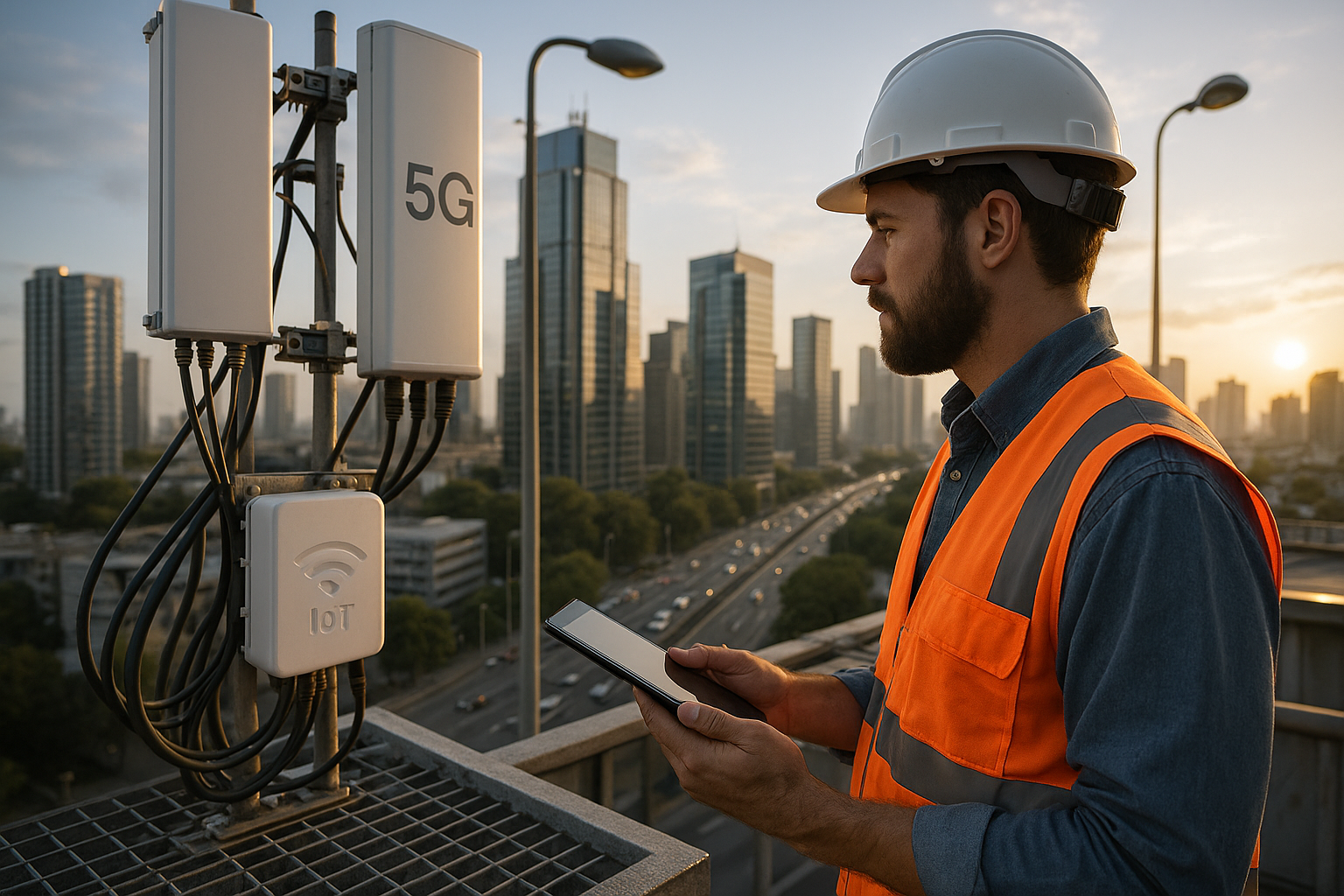
For IoT applications in smart cities, these specifications translate into practical advantages. Sensors monitoring air quality, traffic patterns, structural integrity of bridges, water system performance, and countless other parameters can transmit data instantaneously. The network can simultaneously support up to one million connected devices per square kilometer, creating density sufficient for comprehensive urban monitoring.
Key Technical Enablers for Smart Infrastructure
Several technological components work together to enable this transformation. Edge computing processes data closer to its source rather than sending everything to centralized cloud servers, reducing latency and bandwidth requirements. Network slicing allows operators to create multiple virtual networks tailored to specific applications—emergency services might receive guaranteed high-priority connectivity while parking sensors operate on a lower-priority slice.
Beamforming technology directs wireless signals precisely toward specific devices rather than broadcasting in all directions, improving efficiency and reducing interference. Meanwhile, small cell networks densify coverage through numerous compact base stations, ensuring consistent connectivity throughout urban environments including indoor spaces and areas with challenging topography.
🚦 Transforming Transportation and Mobility Systems
Traffic congestion costs cities billions annually in lost productivity, wasted fuel, and environmental damage. Intelligent transportation systems powered by 5G and IoT offer comprehensive solutions that optimize mobility throughout urban regions.
Connected traffic signals adjust timing dynamically based on real-time vehicle flow data, reducing wait times and improving throughput. Sensors embedded in roadways detect congestion, accidents, and hazardous conditions, automatically rerouting traffic and alerting emergency services. Smart parking systems guide drivers directly to available spaces, eliminating the circling behavior that contributes significantly to urban congestion.
Autonomous Vehicles and Connected Infrastructure
The relationship between self-driving vehicles and smart city infrastructure represents perhaps the most transformative aspect of this technological convergence. Autonomous vehicles require constant communication with surrounding infrastructure and other vehicles—vehicle-to-everything (V2X) communication that demands the ultra-low latency that only 5G can provide.
Traffic signals communicate directly with approaching autonomous vehicles, coordinating movement through intersections without stops. Road sensors detect ice, flooding, or obstacles, transmitting warnings that allow vehicles to adjust routes proactively. The collective data from thousands of connected vehicles creates a comprehensive understanding of traffic patterns, enabling predictive optimization that prevents congestion before it develops.
⚡ Revolutionizing Energy Distribution and Management
Smart grids represent the electricity infrastructure of the future, using IoT sensors and 5G connectivity to balance supply and demand in real-time. Traditional power grids operate as one-way systems—utilities generate electricity and consumers use it. Smart grids transform this relationship into a dynamic, bidirectional network where distributed renewable energy sources, battery storage systems, and variable demand all interact seamlessly.
Solar panels on residential rooftops, commercial buildings, and dedicated solar farms feed excess generation back into the grid when production exceeds local consumption. IoT-connected battery systems store energy during periods of surplus and discharge during peak demand, smoothing out the variability inherent in renewable sources. Smart meters provide granular consumption data, enabling time-of-use pricing that incentivizes shifting demand to off-peak periods.
Intelligent Building Systems and Energy Efficiency
Individual buildings become active participants in urban energy ecosystems through comprehensive IoT integration. Sensors monitor occupancy, ambient light levels, temperature, humidity, and air quality throughout commercial and residential structures. Building management systems use this data to optimize heating, ventilation, air conditioning, and lighting automatically—reducing energy consumption by 20-40% compared to conventional buildings.
Predictive maintenance algorithms analyze performance data from HVAC equipment, elevators, and other building systems, identifying potential failures before they occur. This approach minimizes downtime, extends equipment lifespan, and reduces repair costs while ensuring consistent comfort for occupants.
💧 Smart Water Management for Sustainable Cities
Water scarcity affects billions globally, making efficient water management critical for sustainable urban development. IoT sensors throughout water distribution networks detect leaks that waste precious resources and cause infrastructure damage. In many cities, 25-50% of treated water never reaches consumers due to aging pipes and undetected leaks—losses that smart monitoring can dramatically reduce.
Pressure sensors, flow meters, and acoustic sensors identify abnormal patterns indicating leaks, pinpointing locations for rapid repair. Water quality sensors detect contamination in real-time, automatically isolating affected sections and alerting authorities. Smart irrigation systems in parks and green spaces adjust watering schedules based on soil moisture, weather forecasts, and plant requirements, reducing water consumption while maintaining healthy urban vegetation.
🏥 Enhancing Public Safety and Emergency Response
Connected city infrastructure dramatically improves emergency service effectiveness through real-time situational awareness and optimized response coordination. When accidents occur, connected vehicles automatically transmit location and severity information to emergency services. Traffic management systems create green corridors by coordinating signal timing along emergency vehicle routes, reducing response times that can mean the difference between life and death.
Acoustic sensors detect gunshots and triangulate their location with precision, allowing police to respond within seconds. Video analytics identify suspicious behavior patterns, abandoned packages, or crowd density issues at public events. Environmental sensors monitor air quality, detecting chemical releases or fires before they become widespread emergencies.
Integrated Command and Control Systems
Modern emergency operations centers aggregate data from thousands of IoT sources, presenting comprehensive situational awareness to commanders coordinating responses. During natural disasters, floods sensors track water levels, structural monitors assess building integrity, and communication networks maintain connectivity even when traditional infrastructure fails through resilient mesh networks and mobile base stations.
♻️ Environmental Monitoring and Sustainability Initiatives
Cities account for over 70% of global carbon emissions despite occupying just 2% of Earth’s surface. Smart city technologies enable comprehensive environmental monitoring and evidence-based interventions that reduce urban ecological footprints.
Distributed air quality sensors create detailed pollution maps identifying hotspots and tracking trends over time. This granular data informs targeted interventions—adjusting traffic patterns, identifying industrial sources requiring remediation, or issuing health advisories for vulnerable populations. Noise pollution sensors help cities enforce regulations and plan noise mitigation measures in affected neighborhoods.
Waste management systems optimize collection routes based on actual fill levels from smart bins rather than fixed schedules, reducing fuel consumption and emissions. Recycling programs improve through sensor-equipped bins that identify contamination and provide feedback to users, increasing recycling rates and reducing processing costs.
🏛️ Citizen Engagement and Digital Services
Smart city infrastructure isn’t solely about sensors and automation—it fundamentally transforms how citizens interact with municipal services. Digital platforms connected to underlying IoT infrastructure allow residents to report problems like potholes, broken streetlights, or graffiti through smartphone applications, with city systems automatically routing reports to appropriate departments and tracking resolution.
Interactive kiosks throughout cities provide wayfinding, service information, public WiFi, and emergency communication capabilities. Digital signage adapts messaging based on current conditions—displaying air quality warnings, traffic updates, or event information relevant to each location and time.
🔒 Addressing Security and Privacy Challenges
The extensive data collection inherent in smart city infrastructure raises legitimate concerns about privacy, surveillance, and cybersecurity. Millions of connected sensors create an expanded attack surface that malicious actors could exploit to disrupt critical services or steal sensitive information.
Robust cybersecurity frameworks must be embedded throughout smart city architectures. End-to-end encryption protects data in transit between sensors and control systems. Secure authentication protocols ensure only authorized devices can access networks. Regular security audits identify vulnerabilities before they can be exploited.
Privacy protections require careful policy development alongside technical implementation. Data anonymization techniques allow cities to derive valuable insights about traffic patterns, resource consumption, and service utilization without tracking individual citizens. Transparent policies clearly communicate what data is collected, how it’s used, and who has access, building public trust essential for smart city acceptance.
💰 Economic Implications and Investment Considerations
Transitioning to smart city infrastructure requires substantial upfront investment in sensors, networks, platforms, and integration services. However, economic analyses consistently demonstrate positive returns through operational savings, improved productivity, and enhanced quality of life that attracts talent and business investment.
Energy efficiency improvements alone can save cities millions annually. Optimized traffic flow reduces commuting time, translating to billions in recovered productivity. Predictive maintenance prevents costly infrastructure failures. Improved public safety and environmental quality increase property values and economic activity.
Public-private partnerships offer viable funding models that distribute costs and risks while leveraging private sector expertise. Technology companies gain access to real-world deployment environments and data for innovation, while cities acquire infrastructure without bearing full costs upfront.
🌍 Global Implementation Examples and Lessons Learned
Cities worldwide are implementing smart infrastructure with varying approaches and outcomes. Singapore’s comprehensive smart nation initiative integrates sensors throughout the city-state, creating perhaps the world’s most instrumented urban environment. Barcelona’s sensor network monitors everything from air quality to parking availability, saving the city €42.5 million annually while improving services.
Seoul leverages its advanced telecommunications infrastructure to provide extensive digital services and IoT-enabled public amenities. Dubai aims to become the world’s smartest city through aggressive deployment of AI, blockchain, and IoT across government services. These implementations provide valuable lessons about technical architecture, governance models, citizen engagement, and change management.
🚀 The Path Forward: Building Tomorrow’s Cities Today
The integration of 5G and IoT technologies represents not merely an infrastructure upgrade but a fundamental reimagining of urban life. As these systems mature and proliferate, cities will become increasingly responsive, efficient, and livable. Artificial intelligence and machine learning will enable systems to learn from patterns and optimize operations with minimal human intervention.
Digital twins—virtual replicas of entire cities—will allow planners to model interventions before physical implementation, testing scenarios and predicting outcomes with unprecedented accuracy. Augmented reality will overlay digital information onto physical environments, helping maintenance workers, emergency responders, and citizens navigate complex urban spaces.
The vision of truly smart cities is transitioning from concept to reality. Those cities that embrace this transformation thoughtfully—balancing innovation with security, efficiency with equity, and progress with privacy—will thrive in the decades ahead. The power of 5G and IoT integration offers tools to address humanity’s most pressing urban challenges, creating sustainable, prosperous communities where technology serves human flourishing rather than merely existing for its own sake.
Urban development stands at a pivotal moment. The technologies exist today to revolutionize how cities function, making them cleaner, safer, more efficient, and more responsive to citizen needs. The question is no longer whether smart city transformation is possible, but rather how quickly municipalities can implement these solutions and how effectively they can navigate the technical, social, and governance challenges inherent in such profound change. The cities that succeed will set the standard for urban life in the twenty-first century and beyond.